public 3d-motion repository
freecut
// walterlow/freecut
FreeCut is a professional-grade video editor that runs entirely in your browser. Professional video editing, zero installation. Create stunning videos with multi-track editing, keyframe animations, real-time preview, and high-quality exports.
FreeCut
Edit videos. In your browser.


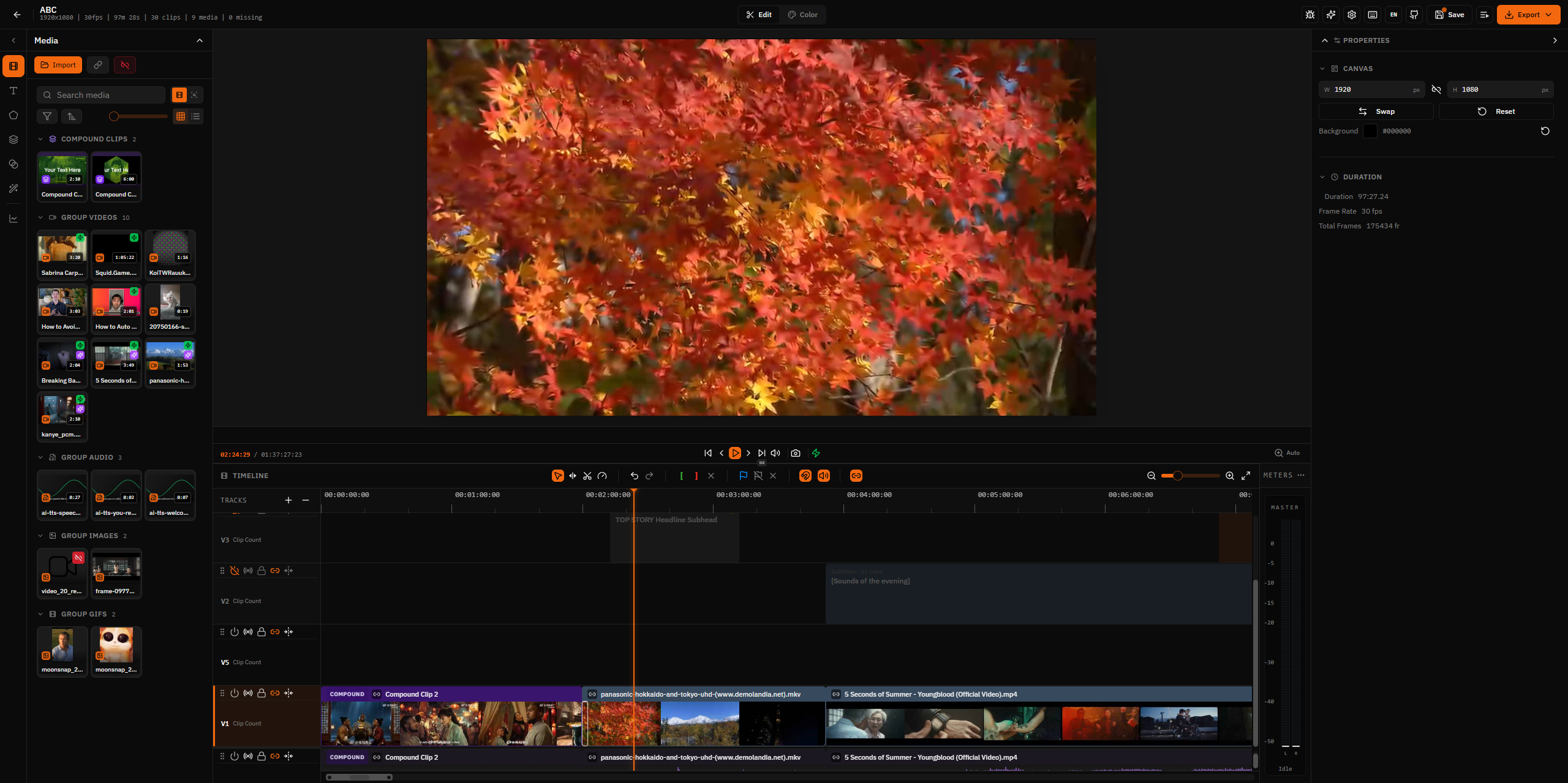
FreeCut is a browser-based, multi-track video editor. No install, no uploads: projects and media stay local, while editing, preview, analysis, transcription, AI generation, and export run in the browser through WebGPU, WebCodecs, Web Workers, OPFS, and the File System Access API.
FreeCut writes projects, linked media metadata, thumbnails, waveforms, generated AI assets, transcripts, scene cuts, and caches as plain files inside a workspace folder you choose on disk.
User Guide
New to FreeCut? Start with the user guide.
Community
Join the FreeCut Discord to share edits, request features, report bugs, and give feedback on browser-based editing workflows.
Screenshots
</td>
<td width="50%">
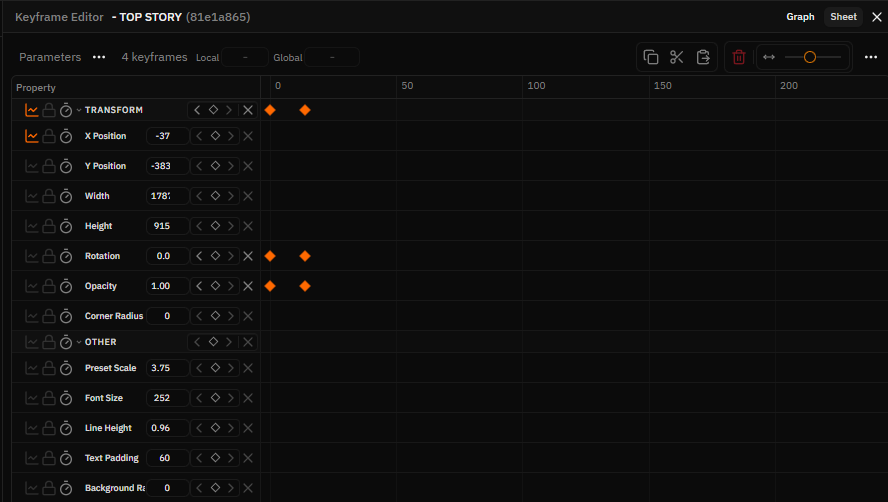
  <strong>Keyframes</strong><br />
</td>
</td>
<td width="50%">
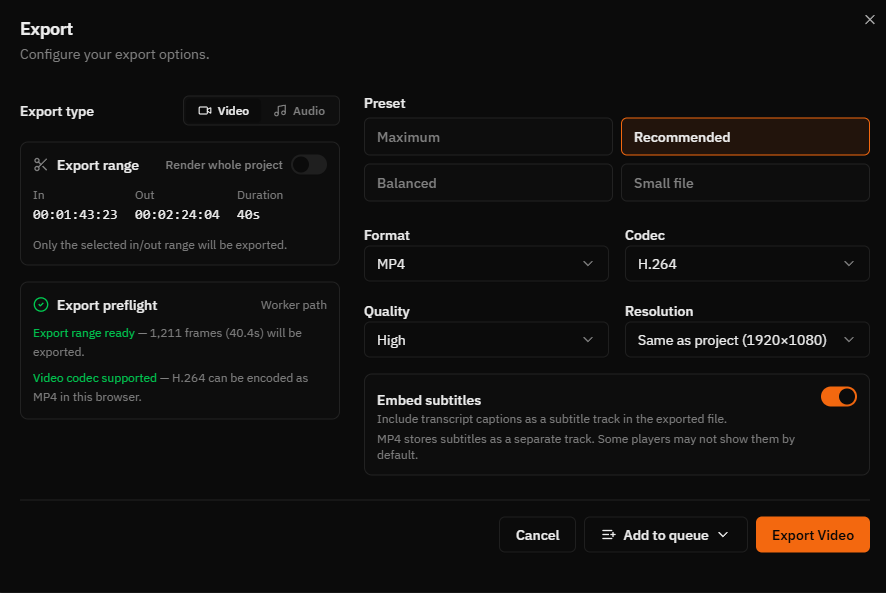
  <strong>Export</strong><br />
</td>
</td>
<td width="50%">
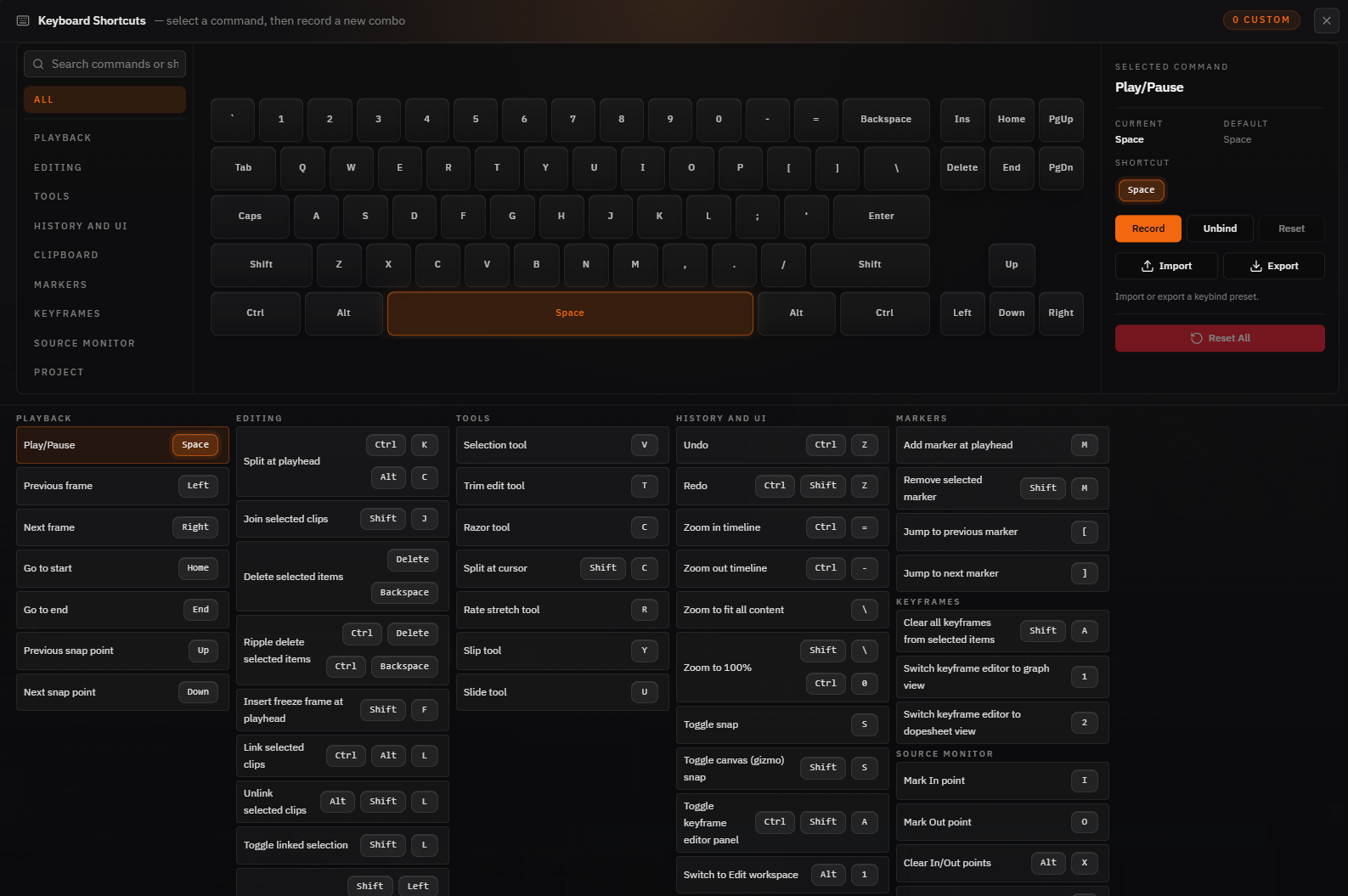
  <strong>Hotkeys</strong><br />
</td>
Features
Timeline & Editing
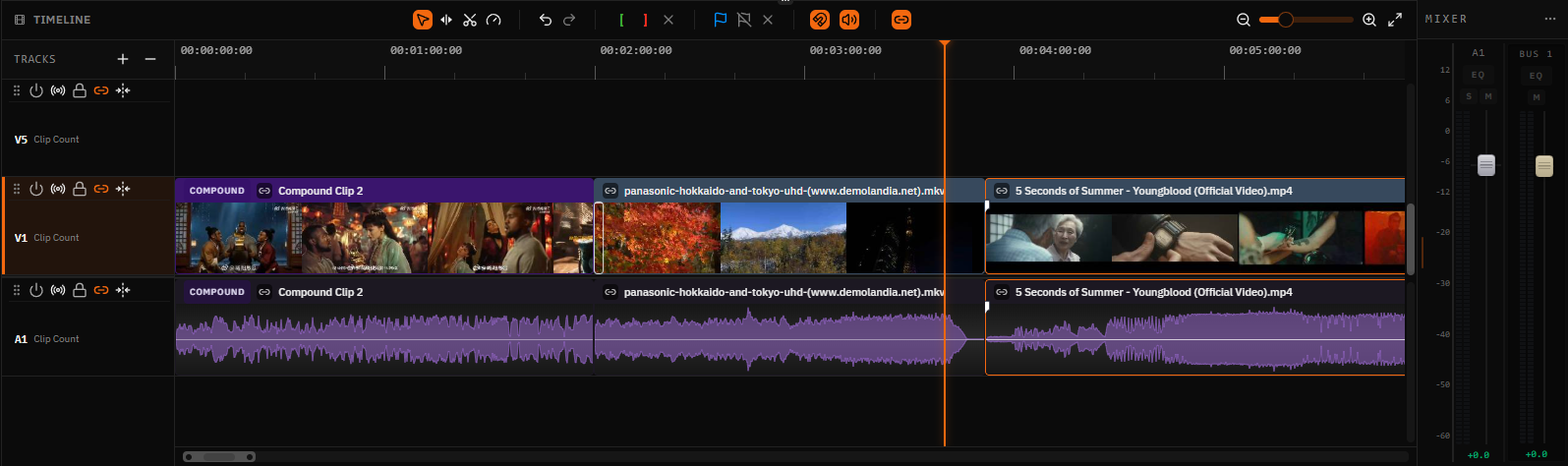
- Multi-track timeline with video, audio, text, image, shape, mask, Lottie, and compound clip items
- Multiple timelines per project as Sequences with tabs, unified with compound clips (open a compound clip as its own sequence)
- Linked audio/video editing with split, join, ripple, rolling, slip, slide, and rate-stretch tools
- Cut-centered transitions with live resize, alignment, source-time anchoring, and preview overlays
- Track mute/visibility/lock controls, linked sync badges, track push/pull, and close-gap workflows
- Filmstrip thumbnails, stereo waveforms, snap guides, markers, timecode, and undo/redo
- Source monitor with mark in/out, patch destinations, insert edits, and overwrite edits
- Project templates, auto-match canvas/FPS from first media, and configurable keyboard shortcuts
Preview & Playback
- Real-time preview with transform, crop, corner-pin, mask, and group gizmos
- Frame-accurate playback through FreeCut's custom
Clockand composition runtime - Fast scrub overlays, decoder prewarming, adaptive preview quality, and source warming
- Two-up and four-up edit panels for ripple, rolling, slip, and slide operations
- GPU color scopes: waveform, vectorscope, and histogram
- Separate project master bus and monitor/device volume
Audio
- Clip volume, audio fades, track faders, master bus fader, and stereo LED meters
- Per-clip pitch shift in semitones/cents with SoundTouch preview playback
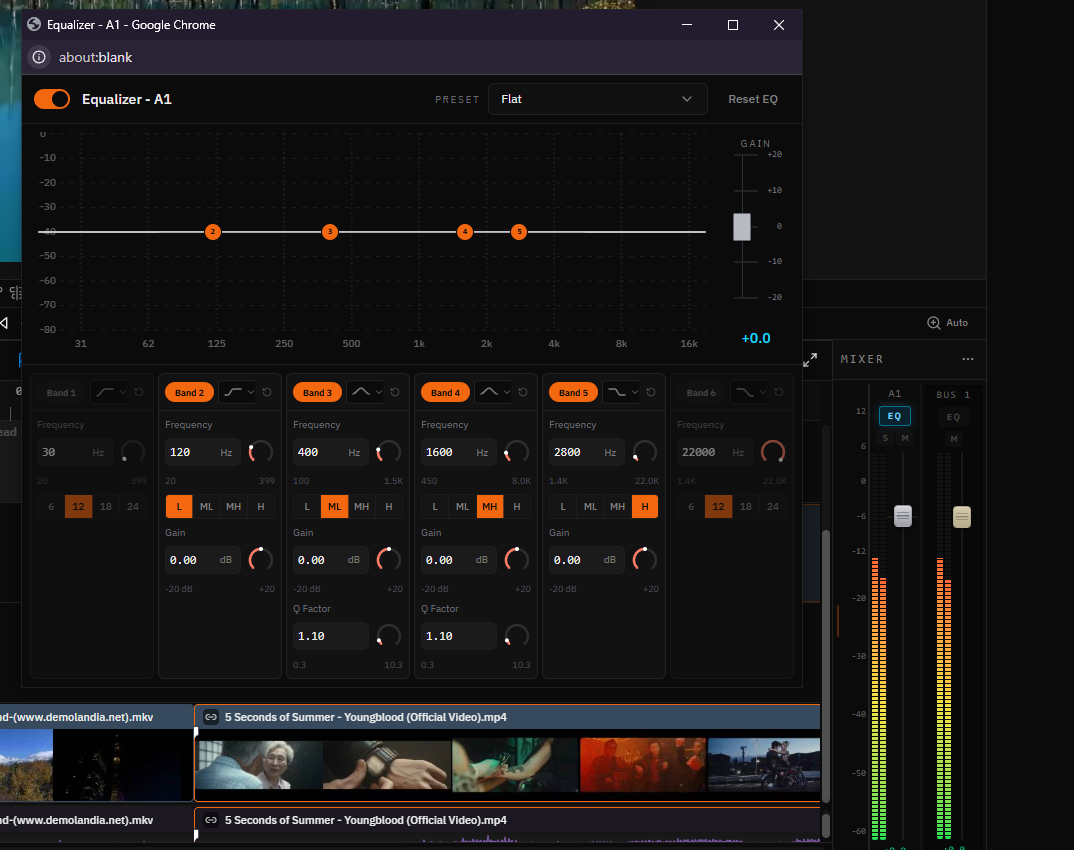
- Clip EQ and track EQ stages, including a compact six-band floating EQ panel
- Pitch, EQ, fades, volume, and transition audio paths are preserved in preview and export
Effects, Masks & Compositing
All visual effects and compositing paths are WebGPU-first, with fallbacks where practical.
- Blur: gaussian, box, motion, radial, zoom
- Color: brightness, contrast, exposure, hue shift, saturation, vibrance, temperature/tint, levels, curves, color wheels, gradient map, LUT (
.cube), grayscale, sepia, invert - Distortion: pixelate, RGB split, twirl, wave, bulge/pinch, kaleidoscope, mirror, fluted glass, ripple glass, glass mosaic, droste
- Stylize: vignette, film grain, sharpen, posterize, glow, edge detect, scanlines, halftone, ASCII art, color glitch, block glitch, VHS, CRT, ink, pixel sort
- Keying: chroma key with tolerance, softness, and spill suppression
- 25 blend modes, including multiply, screen, overlay, soft light, difference, hue, saturation, color, and luminosity
- Clip masks and pen paths with keyframeable geometry transforms
- Color picker with hex and alpha input, plus an in-app eyedropper with loupe
Transitions
- Fade, wipe, slide, 3D flip, clock wipe, and iris transitions with directional variants
- Dissolve, sparkles, glitch, light leak, pixelate, chromatic aberration, and radial blur
- Adjustable duration, alignment, source anchoring, and Canvas 2D fallback for non-WebGPU paths
Keyframe Animation
- Bezier graph editor, dopesheet, split view, and multi-curve overlays
- Easing presets (linear, ease-in/out, cubic-bezier, spring) with a live-preview editor and saved custom presets
- Procedural motion modifiers (drift, sway, breath, spin, shake) evaluated at render time, with one-click bake to keyframes
- Motion text: per-character, per-word, and per-line text animation
- Auto-keyframe mode, tangent mirroring, property accordions, and marquee selection
- Animated transform, crop, mask, text, effect, and color properties
Media & Import
- Import videos, audio, images, GIFs, SVGs, Lottie animations, and generated assets without copying originals
- Edit imported Lottie animations (
.jsonand.lottie): remap colors and themes, edit text, and adjust value slots with live preview - Apple ProRes decode for import, preview, and thumbnails, including variants browsers cannot natively decode
- Proxy generation, thumbnail extraction, waveform caching, and media relinking
Local AI & Analysis
Runs on-device in the browser — nothing is uploaded.
- On-device transcription with the Parakeet engine (Whisper fallback) and generated caption text items
- AI captioning with local vision-language providers and configurable sample cadence
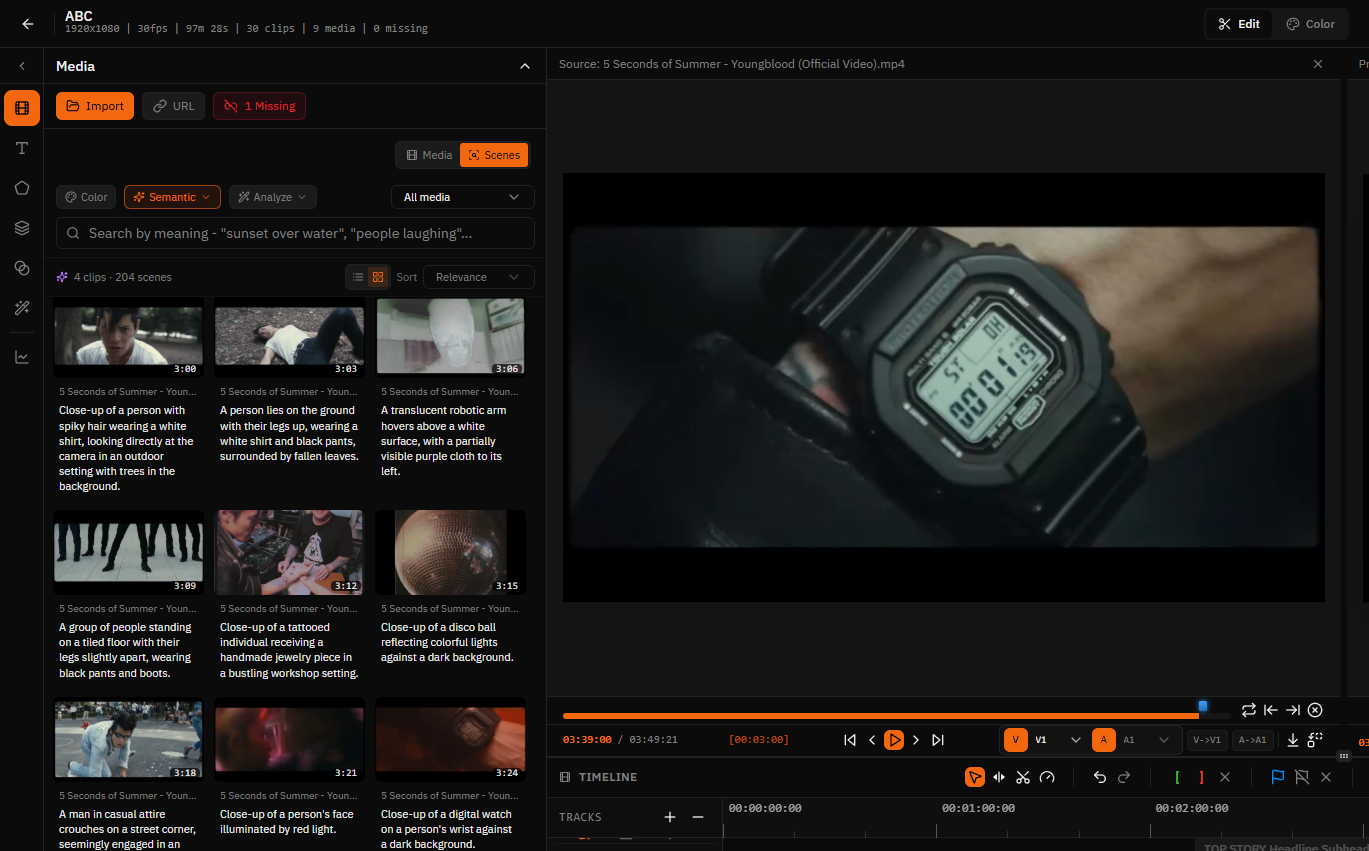
- Scene detection with fast histogram or frame-accurate adaptive content analysis and optional model verification
- Scene Browser for searching captioned media and reusing detected moments
- Local Kokoro text-to-speech voiceovers
- Local MusicGen music generation with presets, progress, and cancellation
- Local model cache controls and unload controls in settings
Projects & Storage
- Workspace folder persistence via the File System Access API
- Multi-workspace switcher with known workspace management
- Projects stored as plain files on disk, with legacy browser-storage migration
- Project soft-delete, restore, empty-trash, and permanent delete flows
- Project ZIP bundle export/import with Zod-validated schemas
- Auto-save, project thumbnails, workspace cache mirroring, and orphan cleanup
Export
- In-browser rendering through WebCodecs and worker-backed render paths
- Export any sequence, not just the main timeline
- Video containers: MP4, WebM, MOV, MKV
- Video codecs: H.264, H.265, VP8, VP9, AV1 (where the browser provides an encoder)
- Audio export formats: MP3, AAC, WAV/PCM
- Subtitles: off, burn-in, sidecar file, or embedded soft track (container-dependent)
- Quality presets from low to ultra, with runtime capability checks and fallbacks
Quick Start
Prerequisites: Node.js 22+ recommended, npm 11+, and a modern Chromium browser.
git clone https://github.com/walterlow/freecut.git
cd freecut
npm install
npm run dev
Open http://localhost:5173 in Chrome, Edge, Brave, or Arc.
Workflow
- Pick a workspace folder when prompted.
- Create a project from the projects page.
- Import media by dragging files into the media library.
- Drag clips to the timeline, then trim, arrange, add effects, transitions, masks, captions, and audio work.
- Use the source monitor, keyframe editor, scene browser, AI tools, and preview overlays as needed.
- Export directly from the browser.
Browser Support
Chrome or Edge 113+ is recommended. FreeCut depends on WebGPU, WebCodecs, OPFS, and the File System Access API, so a modern Chromium browser is required for the full workflow.
Brave
Brave may disable the File System Access API. To enable it:
- Navigate to
brave://flags/#file-system-access-api - Change the setting from Disabled to Enabled
- Click Relaunch to restart the browser
Tech Stack
- React 19 + TypeScript
- Vite+ for dev, build, lint, format, check, and tests
- Vite + @vitejs/plugin-react
- WebGPU for effects, compositing, transitions, masks, scopes, and AI acceleration
- WebCodecs for preview and export pipelines
- File System Access API + OPFS for workspace-backed persistence and caches
- Zustand + Zundo for state management and undo/redo
- TanStack Router for file-based, type-safe routing
- Tailwind CSS 4 + Radix UI + shadcn-style components
- Mediabunny for media decoding, metadata, and audio encoding support
- Transformers.js for local browser AI models
- Kokoro.js for WebGPU text-to-speech
- Web Workers and AudioWorklets for heavy media processing off the main thread
Development
Most commands are npm scripts backed by vite-plus (vp).
npm run dev                 # Dev server on port 5173
npm run build               # Production build
npm run preview             # Preview the production build
npm run perf                # Build + serve a production-like perf target

npm run lint                # Oxlint through Vite+
npm run format              # Oxfmt
npm run test:run            # Run the test suite once (npm run test to watch)
npm run verify              # Full gate: static/arch/unit/build + portable headless contracts
npm run headless:test       # Build once, then run the complete portable headless suite

npm run routes              # Regenerate the TanStack Router route tree
npm run verify runs the complete quality gate, including architecture and
dead-code checks scoped to the current diff, all Node headless contracts, the
built-harness Chrome regression, every public edit operation, and generated
media/audio rendering. Real-GPU effects remain an explicit operator/release
gate because hosted PR CI does not provide a portable WebGPU adapter.
Performance Checks
npm run devis best for correctness and iteration, but includes React/Vite dev overhead, HMR, and debug instrumentation.npm run perfis the better check for real playback or rendering performance because it serves a production build locally.npm run dev:quietkeeps HMR while hiding the editor debug panel.npm run dev:comparestartshttp://localhost:5173andhttp://localhost:4173together for side-by-side dev vs production-like checks.
Environment
VITE_SHOW_DEBUG_PANEL=true # Show debug panel in dev
Project Structure
The src/ tree is organized into a few layers:
features/— user-facing UI modules (editor, timeline, preview, media library, effects, keyframes, export, projects, settings, scene browser, and more)runtime/— playback and rendering engines (composition runtime, player, clock) that are not user-facing UIinfrastructure/— platform adapters for GPU (effects, transitions, compositor, masks, text, scopes), analysis, audio, browser, storage, and thumbnailsshared/— framework-agnostic primitives and cross-feature state (transition engine, schema migrations, Zustand stores, utils)app/,components/,config/,routes/,types/— bootstrap, shadcn/ui components, configuration, file-based routes, and shared types
Feature modules use their local deps/ adapters for cross-feature imports.
Platform-coupled code (GPU, ML, audio, storage, browser) lives in
@/infrastructure/* and is imported directly; there is no separate lib/
layer.
Contributing
FreeCut welcomes contributions that match the current priorities.
Current development priorities, in order:
- Bug fixes across FreeCut.
- Performance improvements for the live editor and playback, plus faster exports.
- New features that have been discussed first.
- Report bugs: open an issue with reproducible steps, your browser version, and screenshots or recordings
- Report performance problems: include the editing or export workflow, source media details, project size, and when the slowdown begins
- Discuss feature ideas: join the FreeCut Discord or start a GitHub Discussion before implementation. New features may be considered, but bug fixes and performance work take priority
License
[INFO] 1 topic link to curated motion topic pages.