public 3d-motion repository
windsurf-simulator
// viachm/windsurf-simulator
A free 3D browser game that teaches real windsurfing physics — sail trim, apparent wind, planing, balance. No install, 20 languages, works on mobile.








You control the same levers a real windsurfer has: sheet angle, mast rake, foot stance, body lean, daggerboard and harness. The board responds the way a real one would. There is no rudder and no arcade shortcut: you steer by moving the sail, you plane when the physics say you can, and you get catapulted when you get greedy with the power.
Nothing to install. Open windsurfsimulator.com on a desktop, tablet or phone.
See it sail
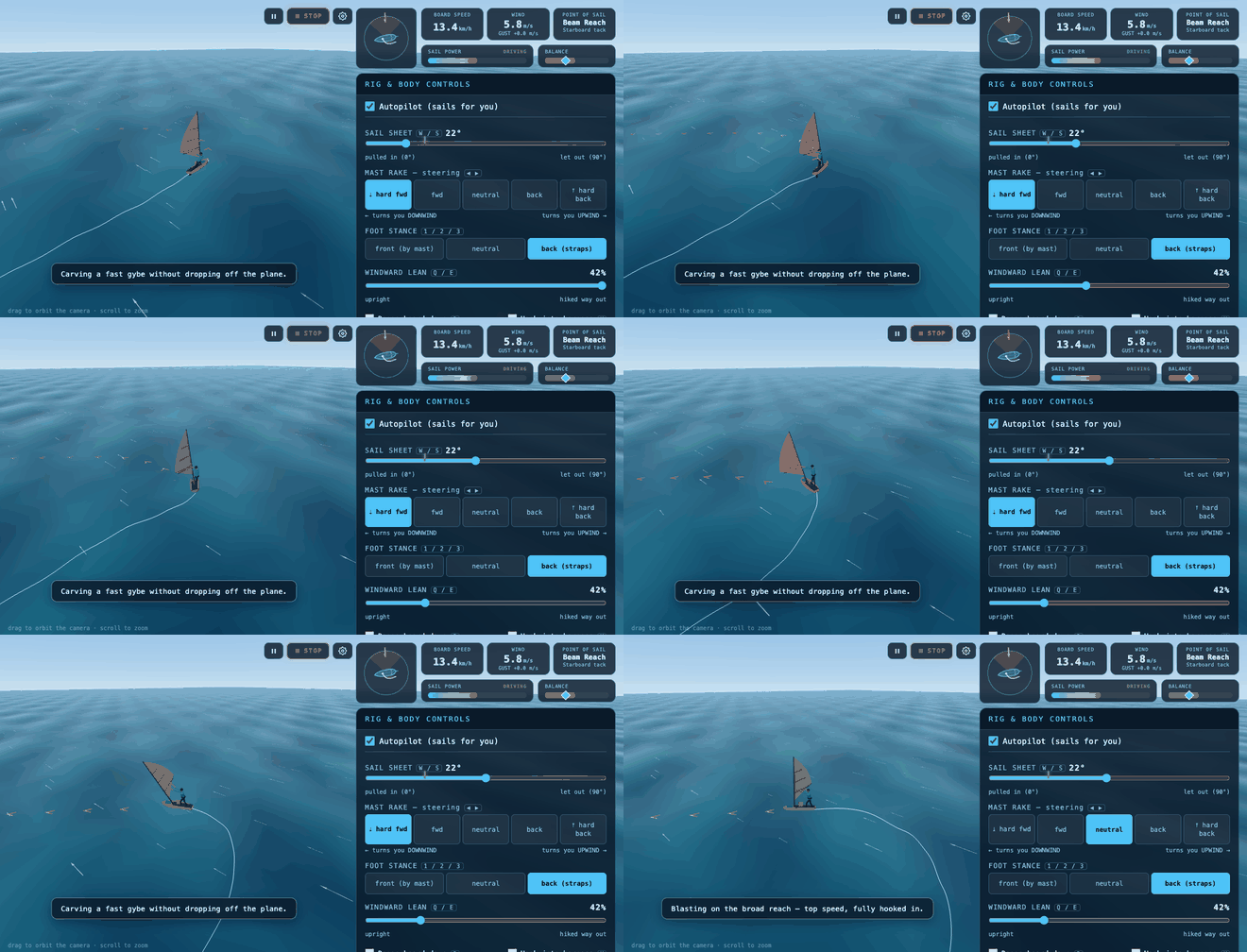
Carve a gybe on the plane
Start on autopilot, or watch a lesson
New riders can leave Autopilot on: it trims the sail and holds your balance, so you can steer and learn the points of sail without falling. Switch it off to practise for real. Or tap ▶ DEMO and the board sails a whole guided lesson by itself (Beginner or Freeride), narrating each step. Touch any control to take over.
On your phone
The physics
| Real mechanic | In the game |
|---|---|
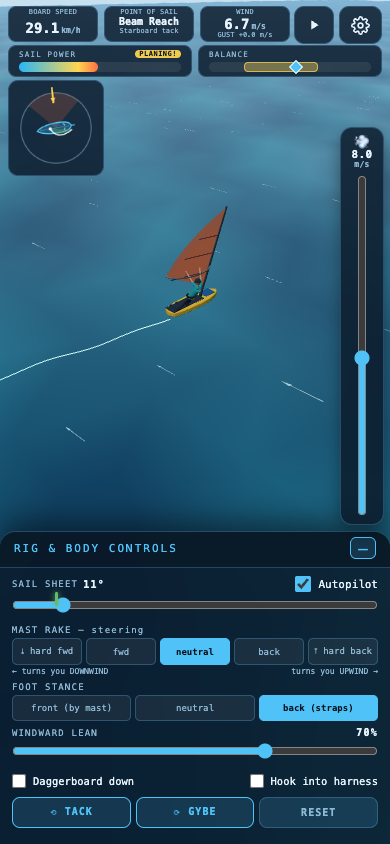
| A sail is an airfoil: its angle of attack controls lift | Sheet slider vs. the moving green "optimal trim" tick. Too far out: luffing (flaps, no power). Too far in: stall (heel force, no drive). |
| Apparent wind swings forward as you accelerate | The optimal trim tick moves toward 0° as you speed up, so you must keep sheeting in. Drive dies when the apparent wind reaches the bow (your natural top speed). |
| No rudder: you steer by moving the sail's centre of effort | Mast rake: back to luff up (turn upwind), forward to bear away (turn downwind). |
| No-go zone, about 45° either side of the wind | The sail cannot drive there; you stop and drift backwards ("in irons"). |
| The rider counters the sideways pull | Windward lean slider and balance meter. Too little lean for the power: catapult. Too much lean when the power dies: you fall in backwards. |
| The daggerboard resists leeway at low speed but lifts violently at high speed | Down: little sideways drift. Up: you slip sideways when slow. Down while planing: spinout crash. |
| Planing: above a speed and power threshold the hull skims and drag collapses | Reach about 8 kn with good power on a beam or broad reach: PLANING badge, big acceleration. Then move back into the straps or you'll pearl the nose. |
| The harness carries the load but commits you | +38% effective lean, but gusts fling you faster when overpowered. Hooking in needs real pull in the sail. |
| Tacking and gybing | Manoeuvres with realistic entry conditions: a tack needs speed and an upwind-ish course, a gybe starts from a broad reach. The sailor switches sides. |
| Hydrofoil | Turn on Foil in settings: a foil replaces the daggerboard, and at speed the board lifts out of the water. |
| Gusts and wind shifts | True wind oscillates ±15% and wanders ±6°. Watch the GUST readout. |
⚠️ It's a learning toy, not a certified trainer. The physics are a faithful simplification meant to build intuition, not to replace time on the water.
Controls
| Do this | Key |
|---|---|
| ⛵ Sheet in / out | W / S (hold) |
| 🧭 Bear away (downwind) / luff up (upwind) | ← / → (hold; the mast rake springs back on release) |
| 🏄 Less / more windward lean | Q / E (hold) |
| 🦶 Stance: front / neutral / back straps | 1 / 2 / 3 |
| ⬇️ Daggerboard up / down | D |
| 🪝 Hook in / out of the harness | H |
| 🔄 Tack / gybe | T / G |
| ↩️ Reset | R |
| 🎥 Orbit / zoom the camera | drag / scroll (pinch on touch) |
- Every control is also in the on-screen panel, so it plays fully by touch on a phone.
- "Smart interlocks" refuse impossible combinations (hooking into a powerless sail, back straps with no speed…) and explain why.
Languages
20 languages: English, Українська, Deutsch, Français, Español, Italiano, Português, Nederlands, Polski, Čeština, Svenska, Dansk, Suomi, Ελληνικά, Türkçe, Bahasa Indonesia, Русский, 中文, 日本語, 한국어. The game picks your browser language and remembers the one you choose. Each has its own page, for example windsurfsimulator.com/uk/.
English and Ukrainian are hand-written; the other 18 are AI-translated and not yet reviewed by native speakers, so corrections are very welcome.
How it's built
- three.js r160 for the WebGL scene, self-hosted so the game loads even where public CDNs are blocked.
- Plain ES modules: no build step, no bundler, no framework.
- Static files on GitHub Pages, deployed by GitHub Actions on every
push to
main.
| File | What it does |
|---|---|
site/src/sim.js | Physics: apparent wind, sail lift curve, points of sail, planing, foiling, balance, crashes |
site/src/world.js | three.js scene: sea shader, wind streaks, board, rig and sailor, splash and wake |
site/src/ui.js | Control panel, interlocks, autopilot, HUD meters, compass |
site/src/demo.js | The guided demo lessons |
site/src/i18n.js | Translations for all 20 languages |
site/src/main.js | Game loop |
Contributing
Issues and pull requests are welcome, especially:
- Translation fixes for any of the 18 AI-translated languages, in
site/src/i18n.js. - Physics tweaks that make a mechanic feel truer to life.
To try a change, serve the site/ folder with any static server (python3 serve.py does it with
caching off) and reload the page.
License
MIT. Made by Viacheslav Mukha, with help from Claude (Anthropic).
[INFO] 4 topics link to curated motion topic pages.