public 3d-motion repository
webgpu-spring-mesh
// erik2810/webgpu-spring-mesh
Real-time GPU particle-mesh spring simulation with interactive node dragging — WebGPU + Three.js TSL compute shaders (Position-Based Dynamics).
WebGPU Spring Mesh


▶ Live demo (requires a WebGPU- or WebGL2-capable browser)
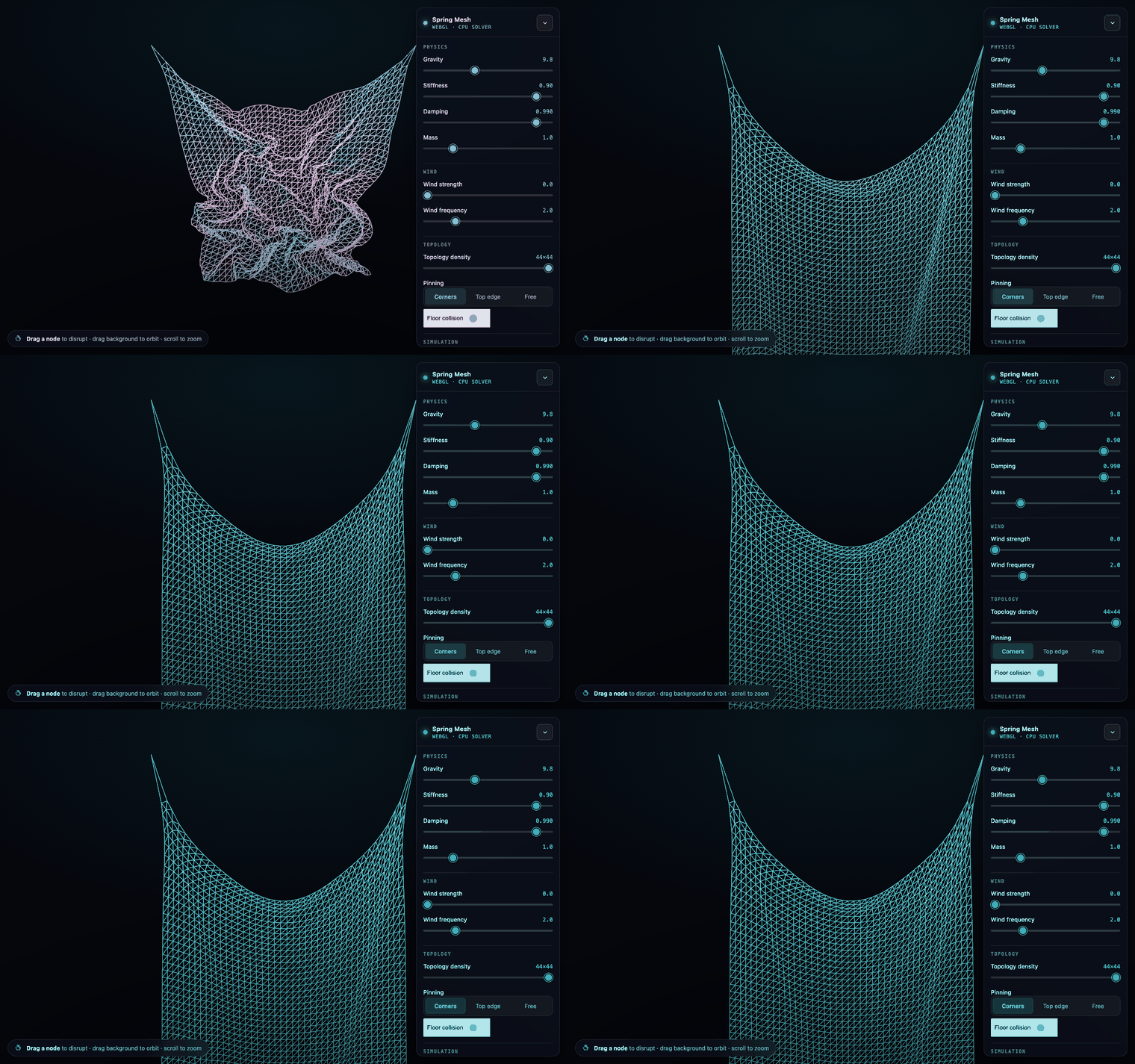
A real-time, GPU-resident particle–mesh spring simulation rendered in the browser with WebGPU compute shaders authored in Three.js TSL (Three Shading Language). A structured lattice of point masses is connected by structural, shear, and bend springs; the entire integration runs on the GPU, and the cloth can be disrupted interactively by clicking and dragging any node. Browsers without WebGPU transparently fall back to a CPU solver rendered through the WebGL2 backend.
This is the browser / "JS view" counterpart to the differentiable spring systems
in jax-spring-sim and Mesh-Based-Physics-Simulator: same mass–spring physics,
here optimized for interactive 60 fps rendering rather than gradients.
                pin                       pin
                 o-----o-----o-----o-----o
                 |  \  |  /  |  \  |  /  |     structural  ──
                 o-----o-----o-----o-----o     shear       ╲╱
                 |  /  |  \  |  /  |  \  |      bend        ┄┄ (2 apart)
                 o-----o-----o-----o-----o
                       ↓ drag a node
Physics
The solver is small-step Position-Based Dynamics (Müller et al. 2007; Macklin, Small Steps in Physics Simulation, 2019), chosen over explicit springs because it is unconditionally stable — no slider combination can blow it up. Each frame is split into substeps; each substep runs three phases:
1. Predict — integrate external forces (gravity $\mathbf{g}$, oscillating wind $\mathbf{w}$) into velocity, then advance positions:
$$ \dot{\mathbf{x}}_i \mathrel{+}= \Big(\mathbf{g} + \tfrac{1}{m},\mathbf{w}(t)\Big)\Delta t, \qquad \mathbf{p}_i = \mathbf{x}_i,\quad \mathbf{x}_i \mathrel{+}= \Delta t,\dot{\mathbf{x}}_i $$
2. Solve — project every distance constraint toward its rest length $\ell_{ij}$ with averaged Jacobi sweeps (relaxation factor $s\in[0,1]$ = "stiffness"):
$$ \Delta\mathbf{x}i = \frac{s}{|\mathcal{N}(i)|}!!\sum{j\in\mathcal{N}(i)} \Big(\lVert\mathbf{x}j-\mathbf{x}i\rVert-\ell{ij}\Big),\hat{\mathbf{d}}{ij} $$
3. Finalize — recover velocity from the constraint-corrected position delta, with per-substep viscous damping $\beta$:
$$ \dot{\mathbf{x}}_i = \beta,\frac{\mathbf{x}_i - \mathbf{p}_i}{\Delta t} $$
Springs follow the standard cloth model (Provot, Graphics Interface '95): 4-neighbour structural ($\ell=h$), diagonal shear ($\ell=h\sqrt2$), and 2-away bend ($\ell=2h$) constraints. Grabbed and pinned nodes are held fixed through all three phases, so the rest of the sheet relaxes around them.
GPU data flow
State lives in storage buffers. The constraint solve is ping-ponged each sweep so neighbour reads never alias the write; an even sweep count lands the result back in buffer A, which the render materials read:
  per substep (compute passes):
    predict ─▶ posA          (gravity/wind, advance)
    solve   ─▶ posA⇄posB     (Jacobi distance projection, ×iterations)
    finalize─▶ posA          (velocity = Δposition / dt, speed for colour)

  render:  InstancedMesh.positionNode ◀── read-only posA
           nodes   = icosahedra, coloured by speed
           springs = screen-facing ribbons, coloured by signed strain
Each kernel builds its own storage nodes so WebGPU access modes are inferred
per-pipeline (sharing a node across a read- and a write-kernel makes TSL mark it
read-only and reject the write). Picking reads positions back once per grab via
getArrayBufferAsync; dragging then projects the pointer onto a camera-facing
plane through the grabbed node.
Controls
| Group | Parameters |
|---|---|
| Physics | gravity, stiffness (0–1), damping, mass |
| Wind | oscillating gust strength and frequency |
| Topology | density (N×N, rebuilds the mesh), pinning mode, floor collision |
| Simulation | substeps per frame, reset, pause |
Append ?cpu to the URL to force the CPU solver even where WebGPU is available.
Drag a node to disrupt · drag the background to orbit · scroll to zoom.
Stack
- Vite + TypeScript build.
- three @ r185 via the
three/webgpu+three/tslentry points. - WebGPU compute and rendering, with an automatic WebGL2 + CPU fallback.
- Hand-written CSS control overlay (no UI framework).
Note: this demo uses vanilla Three.js (not React Three Fiber) for tight control over the compute/render loop, and a hand-rolled CSS overlay instead of Tailwind, to keep the bundle to three.js alone. Both are deliberate deviations from the usual Vite + React + Tailwind stack.
Project layout
webgpu-spring-mesh/
├── index.html
├── package.json
├── vite.config.ts
├── tsconfig.json
├── eslint.config.js
└── src/
    ├── main.ts                 # renderer, scene, loop, sim lifecycle
    ├── style.css               # control overlay styling
    ├── core/
    │   ├── params.ts           # SimParams + defaults
    │   ├── topology.ts         # grid + spring graph construction
    │   └── types.ts            # ClothSim interface
    ├── sim/
    │   ├── ClothSimGPU.ts       # TSL compute solver (WebGPU)
    │   └── ClothSimCPU.ts       # JS solver (WebGL2 fallback)
    ├── interaction/
    │   └── PointerDragger.ts    # raycast pick + drag-to-disrupt
    └── ui/
        └── ControlPanel.ts      # glassy DOM control overlay
Setup
npm install
npm run dev        # http://localhost:5173
npm run build      # type-check + production bundle to dist/
npm run lint       # eslint
npm run typecheck  # tsc --noEmit
base: './' in vite.config.ts keeps the build relocatable, so dist/ can be
dropped into a portfolio sub-path without rewrites.
References
- M. Müller, B. Heidelberger, M. Hennix, J. Ratcliff, "Position Based Dynamics," J. Visual Communication and Image Representation, 2007.
- M. Macklin, M. Müller, N. Chentanez, "Small Steps in Physics Simulation," ACM SIGGRAPH / Eurographics SCA, 2019.
- X. Provot, "Deformation constraints in a mass-spring model to describe rigid cloth behaviour," Graphics Interface, 1995.
- Three.js Shading Language (TSL) — https://github.com/mrdoob/three.js/wiki/Three.js-Shading-Language
[INFO] 3 topics link to curated motion topic pages.