public 3d-motion repository
Levitas
// ashish7802/Levitas
A portfolio-grade aerospace simulation platform exploring gravity, orbital mechanics, and extreme physics concepts.





🚀 Overview
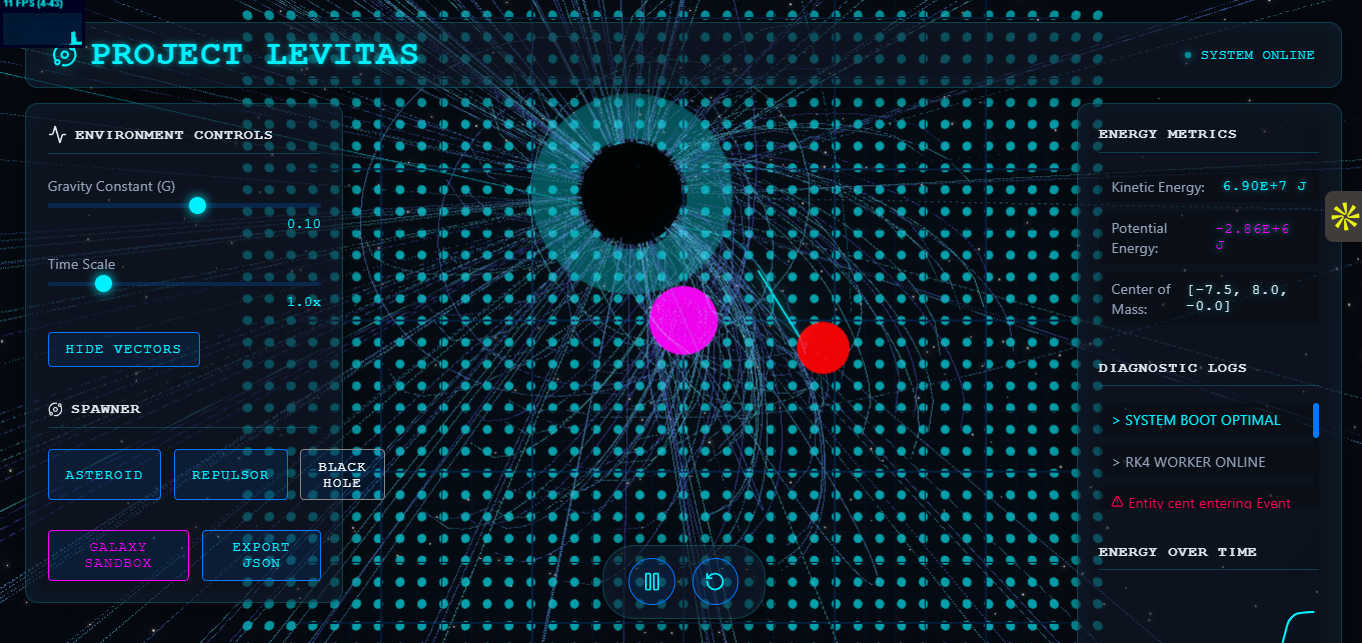
Project Levitas is an elite, browser-based physics simulation engine engineered specifically for complex orbital mechanics and high-density gravitational systems.
Moving beyond traditional rigid-body WebGL demonstrations, Levitas implements a bespoke Velocity Verlet integrator and a recursive Barnes-Hut Octree optimization algorithm, running entirely within a dedicated Web Worker. This decoupled architecture ensures mathematical determinism and numerical stability across millions of calculation steps without degrading main-thread rendering performance.
🌐 Demo
Launch Live Simulation (https://project-levitas.vercel.app/)
✨ Features
- Real-Time N-Body Gravity: Simulates complex multi-body gravitational interactions with strict conservation of momentum.
- Barnes-Hut Optimization: Automatically builds an spatial subdivision Octree to compute forces in $O(N \log N)$ time, enabling the simulation of massive particle clouds and galaxy formations.
- Off-Thread Compute Loop: Physics integration runs in a dedicated Web Worker, preventing heavy mathematical loads from dropping the UI render framerate.
- Velocity Verlet Integrator: Delivers superior energy conservation and numerical stability over long simulation durations compared to standard explicit Euler methods.
- Black Hole Mechanics: Render Event Horizons with extreme tidal thresholds (spaghettification proxy) and customizable gravitational lensing visualizations.
- Real-Time Trajectory Prediction: The engine performs forward-simulation passes asynchronously to visualize deterministic orbital flight paths.
- AI Anomaly Detection: An internal heuristic continuously parses simulation telemetry to automatically log instability warnings and catastrophic capture events.
- Telemetry Dashboards: Live data pipelines inject kinetic/potential energy readouts and center-of-mass vectors directly into DOM-layered charts via Recharts.
- Galaxy Sandbox Preset: Procedurally generate 150+ body parametric spiral galaxies directly from the command UI.
- JSON Export / Import: Fully serialize the simulation vector states to JSON for repeatable experiment analysis.
🏗 Architecture
The platform follows a strict, modular separation of concerns designed for high-throughput visualization applications:
- The Engine Layer (
/src/engine): A pure TypeScript Web Worker environment. Handles matrix allocations, integration steps, Octree traversal, and heuristic evaluations. - The Visualizer (
/src/canvas): A React Three Fiber (@react-three/fiber) renderer. Consumes state payloads and utilizesInstancedMeshalongside@react-three/postprocessing(Bloom, Lensing) for hyper-optimized draw calls. - The State Pipeline (
/src/store): Managed via Zustand. It acts as the sync boundary, passing serializedFloat32Arraydata and telemetry between the Worker and the DOM. - The Interface (
/src/ui): Aerospace-inspired holographic control overlays, featuring hardware-accelerated metric graphing bypassing standard React diffing where necessary for performance.
🛠 Engineering Highlights
- $O(N \log N)$ Scaling: Naive $O(N^2)$ gravity simulations choke the browser beyond ~300 bodies. By clustering distant masses using Center of Mass approximations (Barnes-Hut), Levitas effortlessly handles dense stellar clusters.
- Deterministic Numerical Stability: The Velocity Verlet integrator correctly aligns position and acceleration updates, drastically reducing the "energy drift" typical in standard game physics engines, allowing for stable planetary orbits.
- Zero-Blocking Architecture: By utilizing Web Workers, the main UI thread operates exclusively as a dumb rendering client. The physics engine can compute thousands of steps per frame without triggering browser lockup.
- Memory Efficiency: Heavy object instantiations inside the simulation loop are avoided. Force aggregations utilize pre-allocated
Float32Arraybuffers to eliminate runtime garbage collection stutter.
💻 Tech Stack
- Core: TypeScript, React 18, Web Workers API
- Rendering: Three.js, React Three Fiber, React Three Drei
- Post-Processing: React Three Postprocessing
- State & Data: Zustand, Recharts
- Build & Tooling: Vite, ESLint, TypeScript Compiler
📊 Performance Benchmark (Target Metrics)
Benchmarks captured on standard M1/M2 silicon equivalents (Chrome V8).
| Simulation Scope | Integrator | Force Calc | Render FPS | Worker Compute |
|---|---|---|---|---|
| 50 Bodies | Velocity Verlet | Naive $O(N^2)$ | 60 FPS | < 1ms |
| 500 Bodies | Velocity Verlet | Barnes-Hut | 60 FPS | ~4ms |
| 1500 Bodies | Velocity Verlet | Barnes-Hut | 50-60 FPS | ~12ms |
⚙️ Installation
# 1. Clone the repository
git clone https://github.com/ashish7802/levitas.git

# 2. Navigate into the directory
cd levitas

# 3. Install dependencies
npm install

# 4. Start the Vite development server
npm run dev
🕹 Usage
- Open
http://localhost:5173. - Expand the Spawner tab on the left dashboard.
- Click Galaxy Sandbox to initiate a multi-body simulation.
- Spawn a Black Hole to observe trajectory deviations and AI event warnings.
- Use mouse interactions to Pan/Zoom across the 3D space.
📁 Project Structure
levitas/
├── src/
│   ├── canvas/             # R3F Rendering & Shaders
│   │   └── SimulationLab/  # 3D Entities, Particle Grids
│   ├── engine/             # Math & Physics Logic
│   │   ├── PhysicsEngine.ts# Worker Wrapper & Pipeline
│   │   └── physics.worker.ts# Barnes-Hut & Integrator
│   ├── store/              # Zustand State Management
│   ├── ui/                 # DOM Overlays & Dashboards
│   ├── App.tsx             # Root Orchestrator
│   └── main.tsx
├── public/                 # Static Assets
├── index.html
├── vite.config.ts
├── vercel.json             # Deployment Config
└── tsconfig.json
🗺 Roadmap
- WebGPU Compute Shader integration for $O(N^2)$ calculations on the GPU.
- SharedArrayBuffer implementations for zero-copy state transfers.
- Adaptive timestepping (Runge-Kutta 4) for intense close-encounter scenarios.
- Dynamic spatial partitioning (Grid vs Octree heuristics).
💡 Why This Project?
Project Levitas was engineered as a portfolio piece to demonstrate a deep understanding of full-stack performance optimization, browser architecture, and applied mathematics. It bridges the gap between high-level UI frameworks (React) and low-level performance patterns (Web Workers, Typed Arrays, custom Integrators), proving the capability to architect complex, compute-heavy web applications.
🤝 Contributing
Contributions, issues, and feature requests are highly welcome. Feel free to check the issues page if you want to contribute.
📄 License
This project is MIT licensed.
[INFO] 2 topics link to curated motion topic pages.