public 3d-motion repository
three.quarks
// Alchemist0823/three.quarks
Three.quarks is a general purpose particle system / VFX engine for three.js
three.quarks ✨


three.quarks is a high-performance particle system and visual effects library for three.js, written in TypeScript.
Create stunning real-time VFX for games, interactive experiences, and web applications with an intuitive API and powerful visual editor.
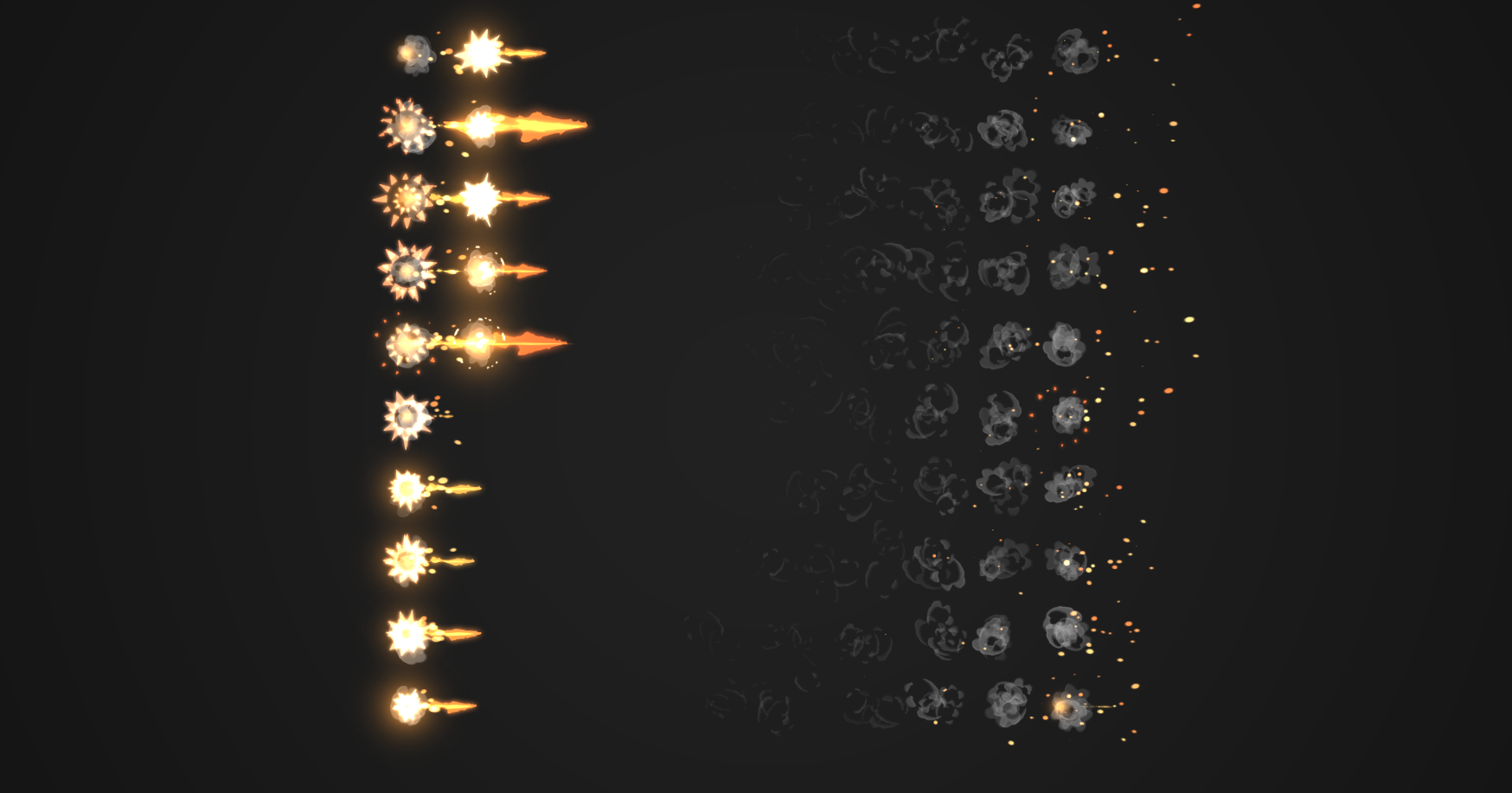
🎮 Try the Demo
▶️ Launch Live Demo - See three.quarks in action with interactive examples!
🔗 Quick Links
| Resource | Description | |
|---|---|---|
| 📖 | Documentation | Official website and guides |
| 🎨 | Visual Editor | WYSIWYG particle effect creator |
| 💬 | Discord | Community support and discussion |
🚀 Why three.quarks?
- ⚡ High Performance - Optimized batch rendering minimizes draw calls
- 🎮 Unity Compatible - Import particle systems from Unity's Shuriken system
- 🎨 Visual Editor - Design effects visually with three.quarks-editor
- 🔧 Flexible - Extensible plugin system for custom behaviors and emitters
- ✅ Production Ready - Used in games and interactive applications
📦 Installation
npm install three.quarks
⚡ Quick Start
import * as THREE from 'three';
import {
    BatchedRenderer,
    ParticleSystem,
    ConstantValue,
    IntervalValue,
    ConstantColor,
    PointEmitter,
    RenderMode
} from 'three.quarks';

// 1. Create the batch renderer (manages all particle systems)
const batchRenderer = new BatchedRenderer();
scene.add(batchRenderer);

// 2. Define your particle system
const particles = new ParticleSystem({
    duration: 2,
    looping: true,
    startLife: new IntervalValue(1, 2),
    startSpeed: new ConstantValue(5),
    startSize: new IntervalValue(0.1, 0.3),
    startColor: new ConstantColor(new THREE.Vector4(1, 1, 1, 1)),
    maxParticle: 100,
    emissionOverTime: new ConstantValue(20),
    shape: new PointEmitter(),
    material: new THREE.MeshBasicMaterial({
        map: yourTexture,
        transparent: true
    }),
    renderMode: RenderMode.BillBoard
});

// 3. Add to scene and renderer
scene.add(particles.emitter);
batchRenderer.addSystem(particles);

// 4. Update in your animation loop
function animate() {
    const delta = clock.getDelta();
    batchRenderer.update(delta);
    renderer.render(scene, camera);
    requestAnimationFrame(animate);
}
🌐 WebGPU (three.js WebGPURenderer)
three.quarks also renders with three.js' WebGPURenderer.
Particle systems, behaviors, emitters and JSON effects are shared; only the batch renderer changes.
It is built on TSL node materials, so it runs on the WebGPU backend and on WebGPURenderer's WebGL2 fallback.
import {WebGPURenderer} from 'three/webgpu';
import {BatchedRenderer, ParticleSystem /* ... */} from 'three.quarks/webgpu';

const renderer = new WebGPURenderer({antialias: true});
await renderer.init();

// 'desktop' (default, full fidelity) | 'mobile' | 'auto'
const batchRenderer = new BatchedRenderer({target: 'auto'});
scene.add(batchRenderer);

renderer.setAnimationLoop(() => {
    batchRenderer.update(clock.getDelta());
    renderer.render(scene, camera);
});
WebGL BatchedRenderer | WebGPU BatchedRenderer (three.quarks/webgpu) | |
|---|---|---|
| Billboard / vertical / horizontal / stretched / mesh / trail | ✅ | ✅ |
Lit mesh particles (MeshStandardMaterial, MeshPhysicalMaterial, env maps) | ✅ | ✅ |
| Sprite sheets, frame blending, alpha test, custom blending, layers, render order | ✅ | ✅ |
| Soft particles | needs a depth pre-pass + setDepthTexture | automatic (reads the framebuffer depth), setDepthTexture still supported |
Targets. desktop gives the same output as WebGL. mobile is tuned for tile-based GPUs: soft particles are off by default (they force a depth resolve and a render-pass split), the sRGB decode uses a pow-free polynomial, and buffers start smaller. Options can be overridden one by one, for example new BatchedRenderer({target: 'mobile', softParticles: true}). getRecommendedRendererSettings(profile) returns a pixel-ratio cap and WebGPURenderer parameters for the target.
Colors and blending. WebGPURenderer blends in a linear framebuffer, while the WebGL particle shaders write display-space colors directly. The default colorSpaceMode: 'webgl-compatible' decodes particle colors so opaque and single-layer pixels look exactly like WebGL. Semi-transparent overlaps blend in linear space and look slightly lighter. For WebGL-identical blending, render through the optional QuarksCompositor: it composites transparent particles in a display-space target, at the cost of two extra full-screen passes.
import {QuarksCompositor} from 'three.quarks/webgpu';

const compositor = new QuarksCompositor(renderer, batchRenderer);
renderer.setAnimationLoop(() => {
    batchRenderer.update(clock.getDelta());
    compositor.render(scene, camera); // instead of renderer.render(scene, camera)
});
Use colorSpaceMode: 'linear' for a fully physically based workflow.
Data layout. Each sprite batch uploads one interleaved buffer per frame (48–64 bytes per particle). WebGPU trails upload one 48-byte storage-buffer record per trail point and are expanded in the vertex shader. Batches of the same kind share one shader build. halfFloat: true packs color, size and velocity as float16 (native Float16Array required). It uploads 25–38% fewer bytes, but in desktop Chrome the conversion costs more CPU than the upload saves, so it is off by default; measure it with benchmark.html on your target device.
React Three Fiber 9. Pass the WebGPU batch renderer to the provider and create WebGPURenderer in the canvas:
import {WebGPURenderer} from 'three/webgpu';
import {WebGPUBatchedRenderer} from 'three.quarks/webgpu';

<Canvas gl={async (props) => { const r = new WebGPURenderer(props); await r.init(); return r; }}>
    <QuarksProvider createBatchedRenderer={() => new WebGPUBatchedRenderer({target: 'auto'})}>
        ...
    </QuarksProvider>
</Canvas>
📂 Loading VFX from JSON
Export effects from the visual editor and load them at runtime:
import { QuarksLoader, QuarksUtil, BatchedRenderer } from 'three.quarks';

const batchRenderer = new BatchedRenderer();
const loader = new QuarksLoader();

loader.load('effects/explosion.json', (effect) => {
    QuarksUtil.addToBatchRenderer(effect, batchRenderer);
    scene.add(effect);
});

scene.add(batchRenderer);
Playing Multiple Instances
// Clone and play the effect multiple times
const instance = loadedEffect.clone();
scene.add(instance);

QuarksUtil.addToBatchRenderer(instance, batchRenderer);
QuarksUtil.setAutoDestroy(instance, true); // Auto-cleanup when finished
QuarksUtil.play(instance);
⚛️ React Three Fiber
Use the quarks.r3f package for declarative React integration:
npm install quarks.r3f three.quarks
import { Canvas } from '@react-three/fiber'
import { QuarksProvider, ParticleSystem } from 'quarks.r3f'
import { ConeEmitter, SizeOverLife, PiecewiseBezier, Bezier, RenderMode } from 'three.quarks'

function FireEffect() {
    const shape = useMemo(() => new ConeEmitter({ angle: 0.3, radius: 0.2 }), [])
    const behaviors = useMemo(() => [
        new SizeOverLife(new PiecewiseBezier([[new Bezier(1, 0.5, 0.2, 0), 0]]))
    ], [])

    return (
        <ParticleSystem
            duration={5}
            looping
            startLife={[1, 2]}
            startSpeed={[2, 4]}
            startSize={0.5}
            startColor={{ r: 1, g: 0.5, b: 0.2, a: 1 }}
            emissionOverTime={40}
            shape={shape}
            renderMode={RenderMode.BillBoard}
            behaviors={behaviors}
            position={[0, 0, 0]}
            autoPlay
        />
    )
}

function App() {
    return (
        <Canvas>
            <QuarksProvider>
                <FireEffect />
            </QuarksProvider>
        </Canvas>
    )
}
See quarks.r3f documentation for full API reference.
✨ Features
🎬 Renderers
- WebGL (
three.quarks) and WebGPU (three.quarks/webgpu) batch renderers - Billboard - Camera-facing sprites
- Stretched Billboard - Velocity-aligned sprites
- Mesh - 3D geometry particles
- Trail - Ribbon trails behind particles
📐 Emitter Shapes
- Point, Sphere, Hemisphere, Cone, Circle
- Mesh Surface - Emit from 3D model surfaces
- Grid - Structured emission patterns
🎭 Behaviors
- Color over lifetime
- Size over lifetime
- Rotation over lifetime
- Force fields
- Orbital motion
- Texture animation
- Sub-emitters
- Custom behaviors via plugin system
🎨 Materials
- MeshBasicMaterial (unlit)
- MeshStandardMaterial (PBR)
- Configurable blending modes
- Texture atlas support
🧪 Examples
Browse the examples folder or run locally:
npm install
npm run build
npm run examples
Open vanilla.html (WebGL), vanilla-webgpu.html (same demos on WebGPU, ?target=desktop|mobile|auto) or
benchmark.html (WebGL vs WebGPU frame timings). node packages/quarks.examples/scripts/build-showcase.mjs builds
a static, bundler-free copy of the demos and the benchmark.
📦 Packages
This project is a monorepo with modular packages:
| Package | Description |
|---|---|
| three.quarks | 🎯 Main package - Three.js particle system with batched rendering, shaders, and full VFX toolkit |
| quarks.core | 🧱 Core library - Framework-agnostic math, behaviors, emitter shapes, and functions (zero dependencies) |
| quarks.r3f | ⚛️ React Three Fiber - Declarative R3F components with hooks, Suspense support, and flexible props API |
| quarks.nodes | 🔮 Node system - Experimental node-based VFX with visual programming and WebGPU compute support |
| quarks.examples | 🎮 Examples - Interactive demos showcasing particle effects and features |
| quarks.playground | 🧪 Playground - Development sandbox for testing and experimenting with effects |
🛠️ Editor
- three.quarks-editor - Visual editor for creating and previewing particle effects with real-time preview and JSON export
📚 Resources
- Change Log
- Contributing Guide
- Development Guide
- Code of Conduct
- CodeSandbox Example
- React Three Fiber Package - Official R3F integration
🗺️ Roadmap
- 🔲 WebGPU rendering support
- 🔲 WebAssembly particle simulation
- 🔲 Node-based scriptable particle systems
- 🔲 Cross-platform native plugins
📄 License
MIT